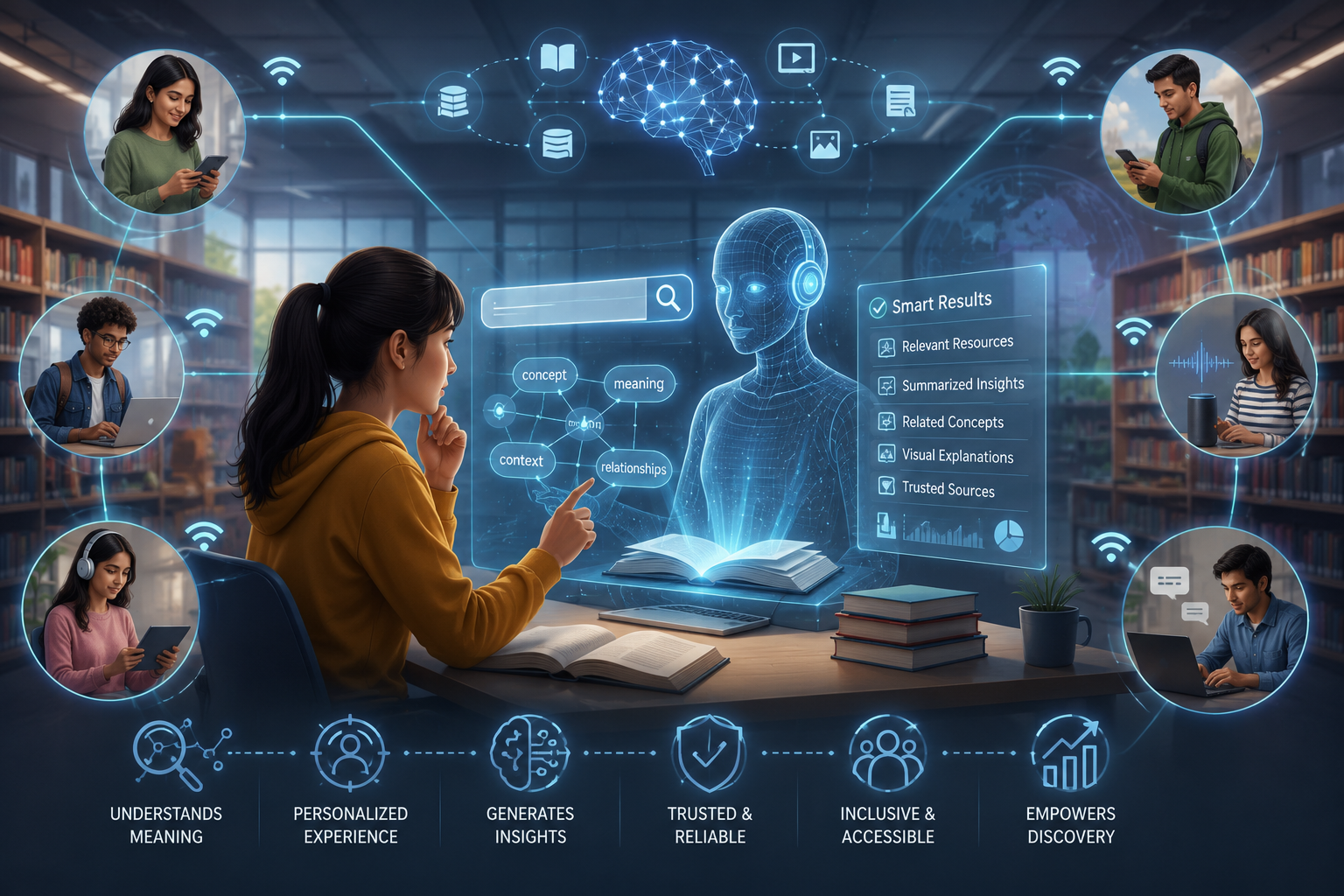
Libraries have long served as gateways to knowledge, connecting users with information resources that support learning, research, innovation, and lifelong education. Traditionally, library users depended on card catalogues, printed indexes, bibliographies, and reference services to locate relevant information. With the emergence of computers and digital technologies, information retrieval systems transformed library operations by enabling faster access to vast collections of books, journals, databases, multimedia resources, and digital repositories.
The rapid growth of digital information has created new challenges for information retrieval. Modern users often face difficulties in locating precise and relevant information because of the enormous volume of available content. Conventional search systems primarily rely on keyword matching, which may not always understand the actual meaning or context of a user's query. As a result, users frequently receive either too many irrelevant results or fail to discover valuable resources hidden within digital collections.
Recent developments in Artificial Intelligence (AI), particularly Semantic Search and Generative AI, are revolutionizing information retrieval systems. These technologies enable computers to understand the meaning, context, intent, and relationships among concepts rather than simply matching words. Consequently, libraries are moving toward intelligent information retrieval systems that provide more accurate, personalized, and user-centered search experiences.
For the next generation of library users, who are accustomed to intelligent digital assistants, conversational interfaces, and instant access to information, traditional search methods are no longer sufficient. Semantic search and generative AI offer powerful solutions that can transform library services, improve resource discovery, and enhance knowledge access in unprecedented ways.
This lecture explores the concepts of semantic search and generative AI, their applications in information retrieval systems, their significance for modern libraries, associated challenges, and future prospects.
- Teacher: Biswajeet Sahoo