
To learn the fundamentals of computer and its working mechanism.
To learn programming paradigms and design.
To learn the basics of Python Programming for problem solving.
To learn the fundamentals of computer and its working mechanism.
To learn programming paradigms and design.
To learn the basics of Python Programming for problem solving.
This course jbvkbvkj
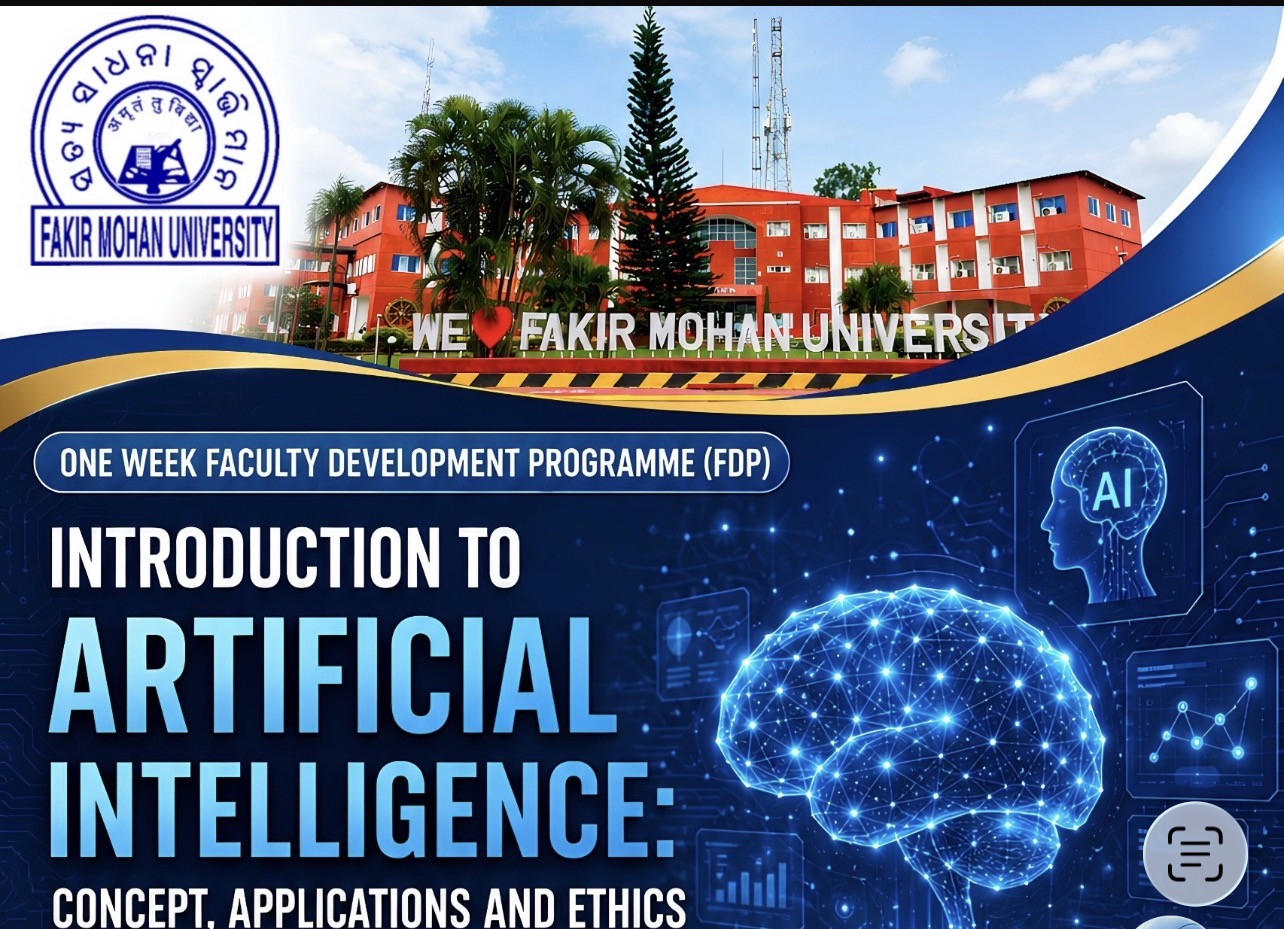
Introduction to Artificial Intelligence is a 3-credit Value Added Course (VAC) designed for UG students of the 5th Semester across Arts, Science and Commerce streams. The course provides a broad, interdisciplinary introduction to Artificial Intelligence (AI), its evolution, fundamental concepts, applications, tools, and its ethical, social, economic and legal implications.
The course begins with the foundations of AI, introducing intelligence, intelligent machines, smart systems, the history and evolution of AI, problem-solving and search techniques, rule-based systems, Natural Language Processing (NLP), and Computer Vision. It then introduces the fundamentals of Machine Learning, covering supervised, unsupervised and reinforcement learning, training data, regression, classification, clustering, neural networks, decision trees, k-NN and introductory deep learning.
A major component of the course focuses on real-world AI applications and hands-on exposure to contemporary AI tools such as ChatGPT, Gemini, Copilot, Claude, Canva AI, Google Teachable Machine, Runway ML, DALL·E, Adobe Firefly, Pictory and Google AI Studio. Students explore AI applications relevant to their respective disciplines through Arts, Science and Commerce-specific learning tracks, enabling them to understand how AI is transforming their academic and professional fields.
The course also develops awareness of Responsible and Ethical AI, addressing algorithmic bias, fairness, privacy, surveillance, misinformation, deepfakes, intellectual property, employment, human-AI collaboration, the digital divide, security, AI governance and sustainable AI development.
Finally, students undertake a group mini-project based on a real-life problem or existing AI system relevant to their stream. They are expected to conceptualize an AI-based solution or critically evaluate an existing AI tool, considering its applications, limitations and ethical implications, followed by a report and seminar presentation.
By the end of the course, students will be able to understand the fundamental concepts of AI and Machine Learning, recognize and use contemporary AI tools, identify AI applications in their respective disciplines, critically examine the ethical and societal implications of AI, and conceptualize responsible AI-based solutions to real-world problems.
In essence, the course moves students through the journey:
Understand AI → Explore Machine Learning → Experience AI Tools → Examine AI's Impact → Apply AI to Real-World Problems.